Structure, not a tone knob
The intended harmonic contribution changes with the incoming signal instead of remaining a permanent static coloration.
TUBE + VINYL · Explicit analogue modelling
NeuraMuse does not hide analogue colour behind a generic enhancement switch. TUBE and VINYL are separate paths with their own behaviour, telemetry and identity — always comparable against DIRECT.
TUBE · Living Valve
TUBE is designed around dynamic analogue behaviour rather than a fixed “warm” EQ curve. Its response can evolve with level, crest, programme density and transient structure.
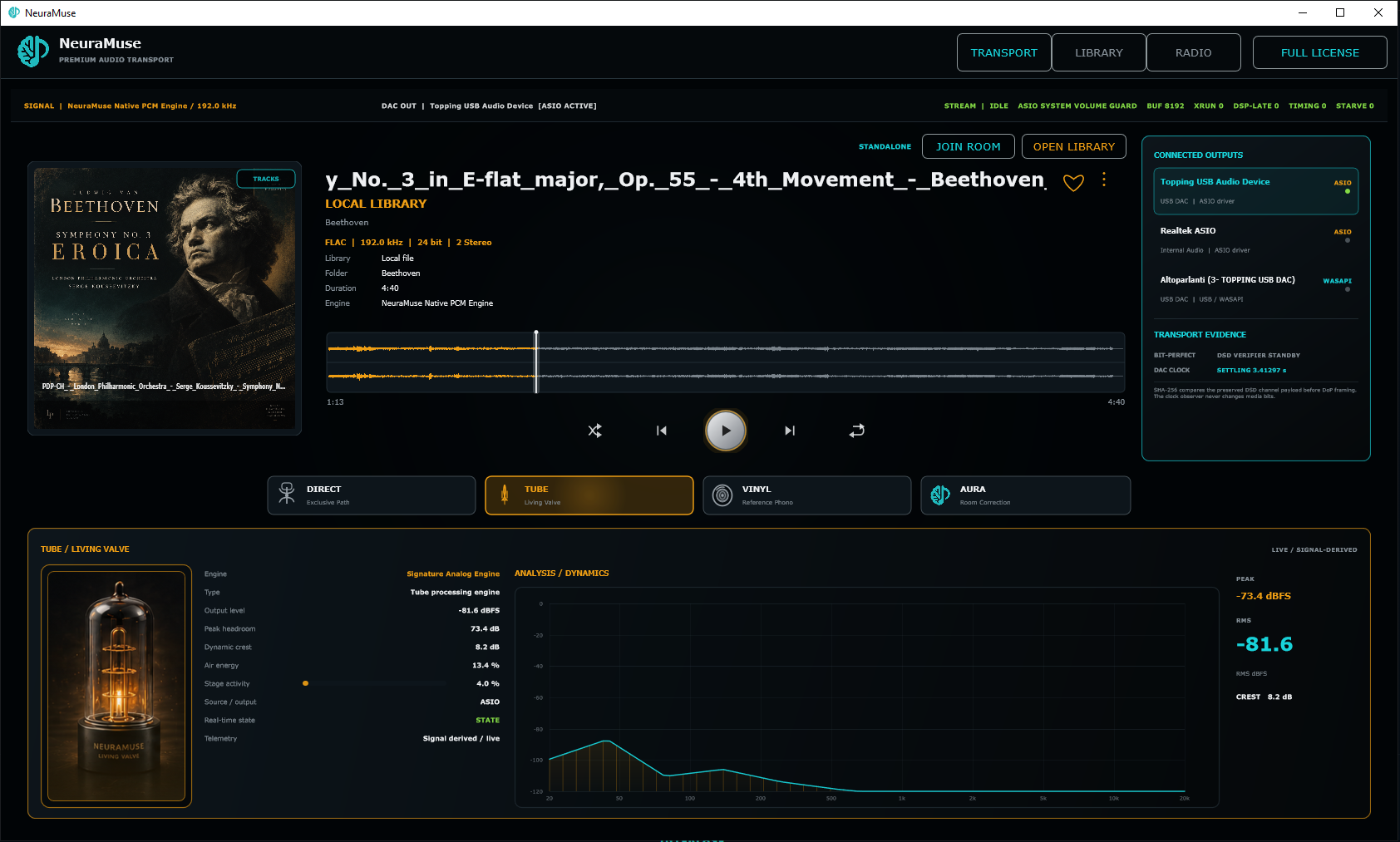
The live panel exposes stage activity, air energy, dynamic crest, headroom and output state while the model is running, keeping the processing path legible.
The intended harmonic contribution changes with the incoming signal instead of remaining a permanent static coloration.
Programme level and transient structure influence the model instead of flattening every recording into one signature.
DIRECT remains available as the neutral comparison whenever you want to judge what TUBE is doing. If the current source is DSD and has already entered TUBE, bit-perfect DSD resumes at the next track boundary.
VINYL · Reference Phono
VINYL is built as its own playback path. The model is organised around groove/stylus behaviour, compliance interaction, phono-stage processing, timebase behaviour and a coupled output stage.
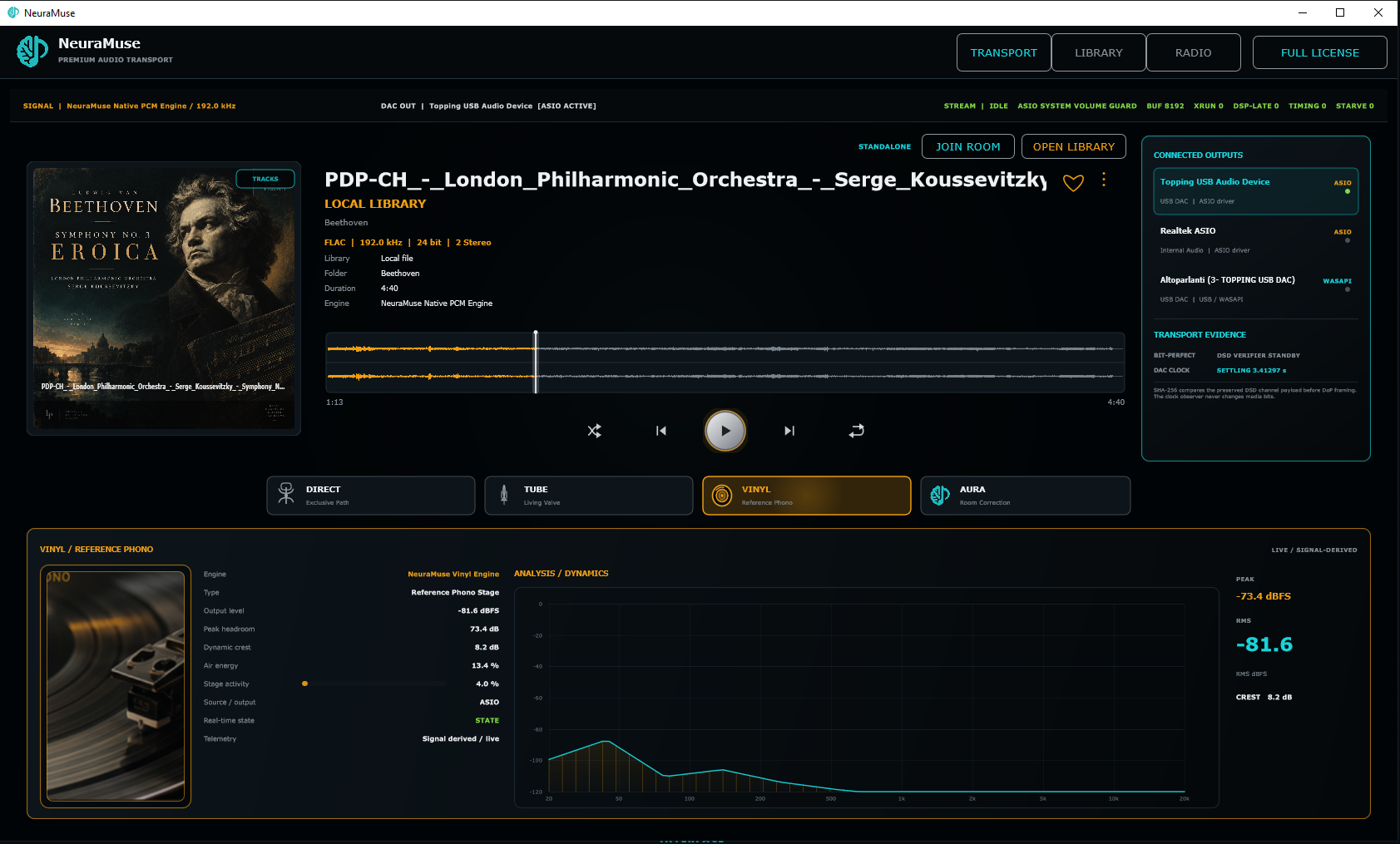
The live panel presents stylus contact, suspension behaviour, phono stage, timebase, valve stage, headroom and the final signal route. The product proposition is the modelled playback chain, not nostalgia noise.
The model represents time-dependent mechanical interactions in addition to spectral behaviour.
VINYL is treated as a source-to-output model with an explicit phono identity.
Return to DIRECT whenever you want the reference path. If the current source is DSD and has already entered the processed path, bit-perfect DSD resumes at the next track boundary.
Three-way comparison
The point of separate paths is not to declare one universally superior. It is to make the choice audible, visible and reversible.
No analogue modelling. Use it as the control condition.
Dynamic nonlinear and harmonic/stage behaviour that follows the programme.
A broader phono-style playback model with mechanical and electrical interactions.
Listen, switch, decide
Install NeuraMuse, start in DIRECT, then compare TUBE and VINYL on your own system.